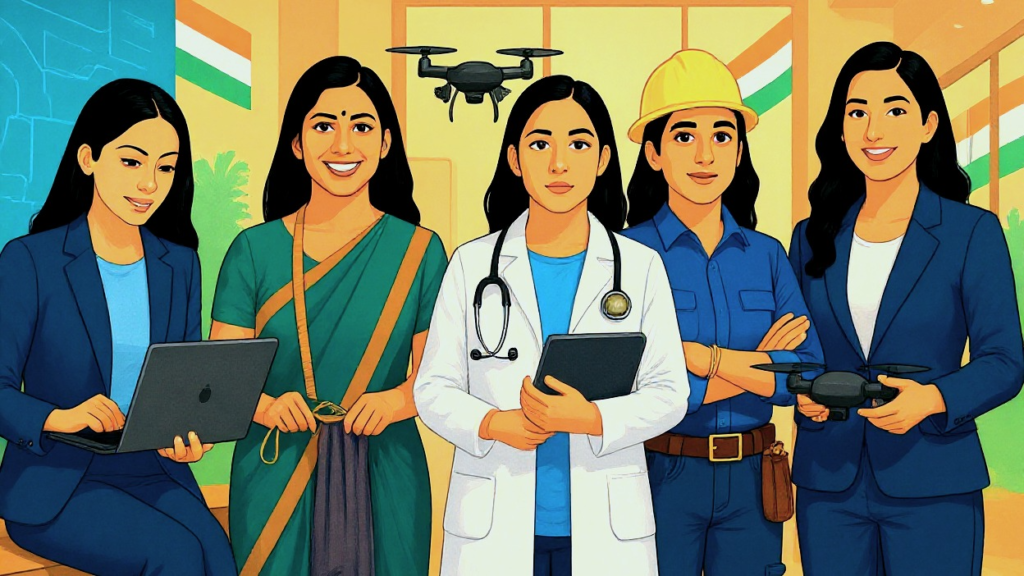
In a few years, someone will apply for a job that doesn’t exist today. They might be training AI models to detect mental health patterns. Or designing ethical guidelines for human-robot collaboration in hospitals. Or engineering biodegradable materials to replace single-use plastics in supply chains. That person could be sitting in a training center right now, learning how to adapt. The future remains uncertain, but one truth is already clear: the ability to learn continuously, across disciplines and industries, will define who thrives.
This is not a story about fear. It’s a story about possibility.
A World That’s Changing—for the Better
We often talk about the future of work in tones of worry: automation, job displacement, AI disruption. But look closer, and a different story emerges. One of expansion. Of reinvention. Technology is not replacing jobs, it’s unlocking entire new categories of human potential. Creative technologists. Drone traffic analysts. Sustainability designers. Roles that once sounded speculative are becoming mainstream.
We are not shrinking as a species. We are evolving.
The Most Valuable Skill? Learning to Learn
The half-life of a skill is now about five years. In some sectors, even less. What this means is that people won’t just change jobs—they’ll change industries, sometimes multiple times over a lifetime.
Traditional skilling programs, designed around fixed job roles, are simply not enough. What we need are learning environments that build agility, not just ability.
That means:
Encouraging curiosity over memorization
Teaching people how to think, not what to think
Shifting from content delivery to problem-solving experiences
The goal is not just to prepare someone for a job. It’s to prepare them for jobs they’ve never seen before.
Transferable Skills Are the New Core Skills
Some skills will always matter, no matter what the future looks like. Collaboration. Empathy. Storytelling. Critical thinking. These are not “soft” skills. They are resilient skills, the ones that carry across industries, survive automation, and give people the confidence to switch paths.
A healthcare worker who can communicate with empathy. A retail employee who can solve problems in real time. These are the people who will always find a way forward, even when the landscape shifts beneath them.
Skilling as a Catalyst for Confidence
At its best, skill development is not just about employability. It’s about dignity. Confidence. Choice. It’s the ability to say: “I may not know what tomorrow brings, but I know I can learn my way through it.”
This is the deeper impact of skilling. Not just preparing someone to earn, but preparing them to evolve. It’s about giving people the tools to shape their lives on their own terms.
A Hopeful Blueprint
What if we stopped fearing the jobs that haven’t been invented yet, and started preparing people to invent them? What if we viewed skilling not as a backup plan, but as a launchpad for innovation?
What if learning wasn’t a phase—but a way of life? The future of work doesn’t have to be overwhelming. With the right mindset, it can be empowering. Those who embrace change, stay curious, and keep building themselves won’t just be prepared for what’s next. They’ll be the ones creating it. At Adani SAKSHAM Centres, we’re cultivating the mindset, adaptability, and resilience needed to thrive in the unknowns of tomorrow.