☰
☰

Building digital capability
for a
connected world

Building digital capability
for a

From data to devices, these courses prepare learners to work with the systems shaping modern industry.

Building digital capability
for a

From data to devices, these courses prepare learners to work with the systems shaping modern industry.

Foundation of AI
Course Overview
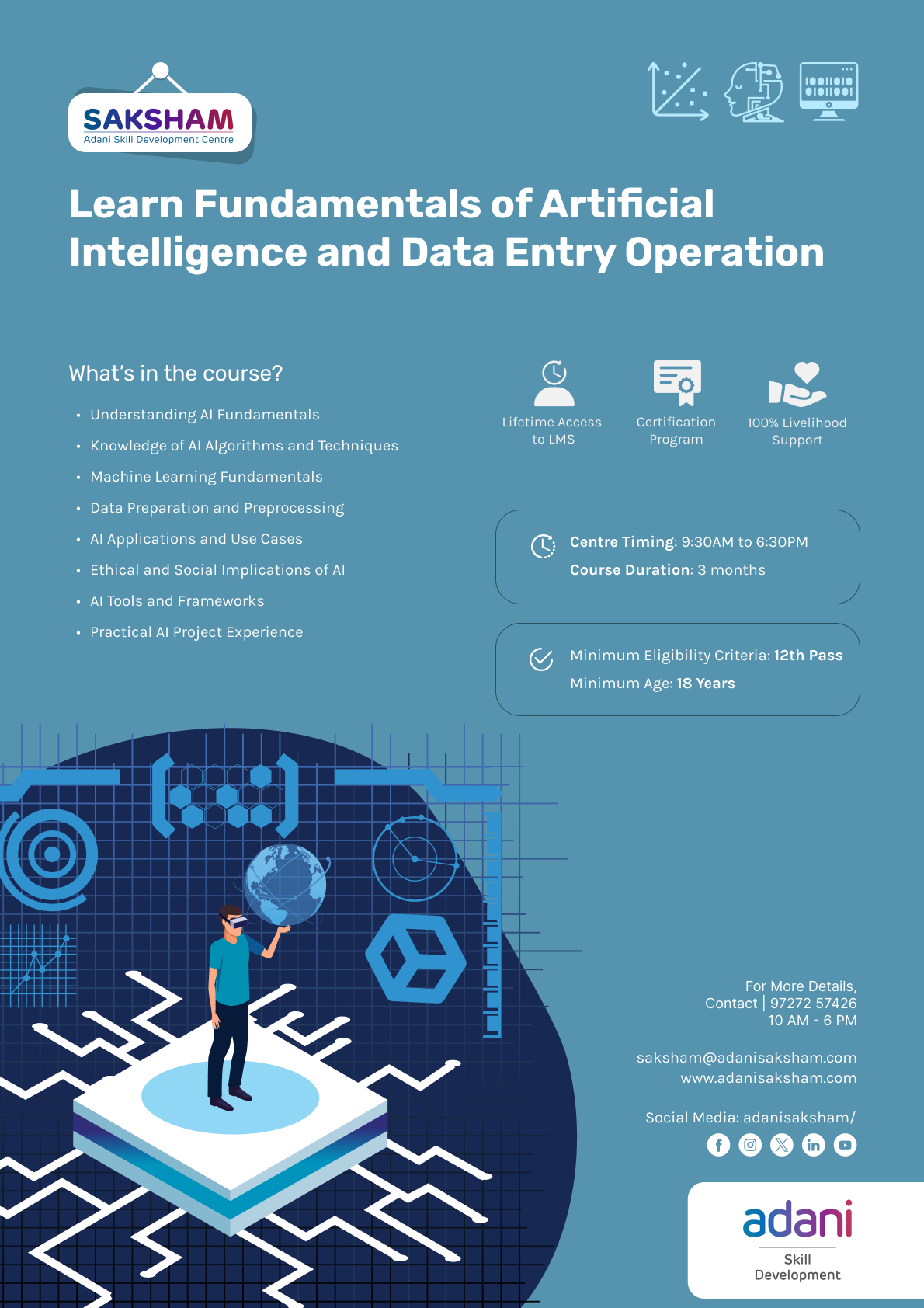
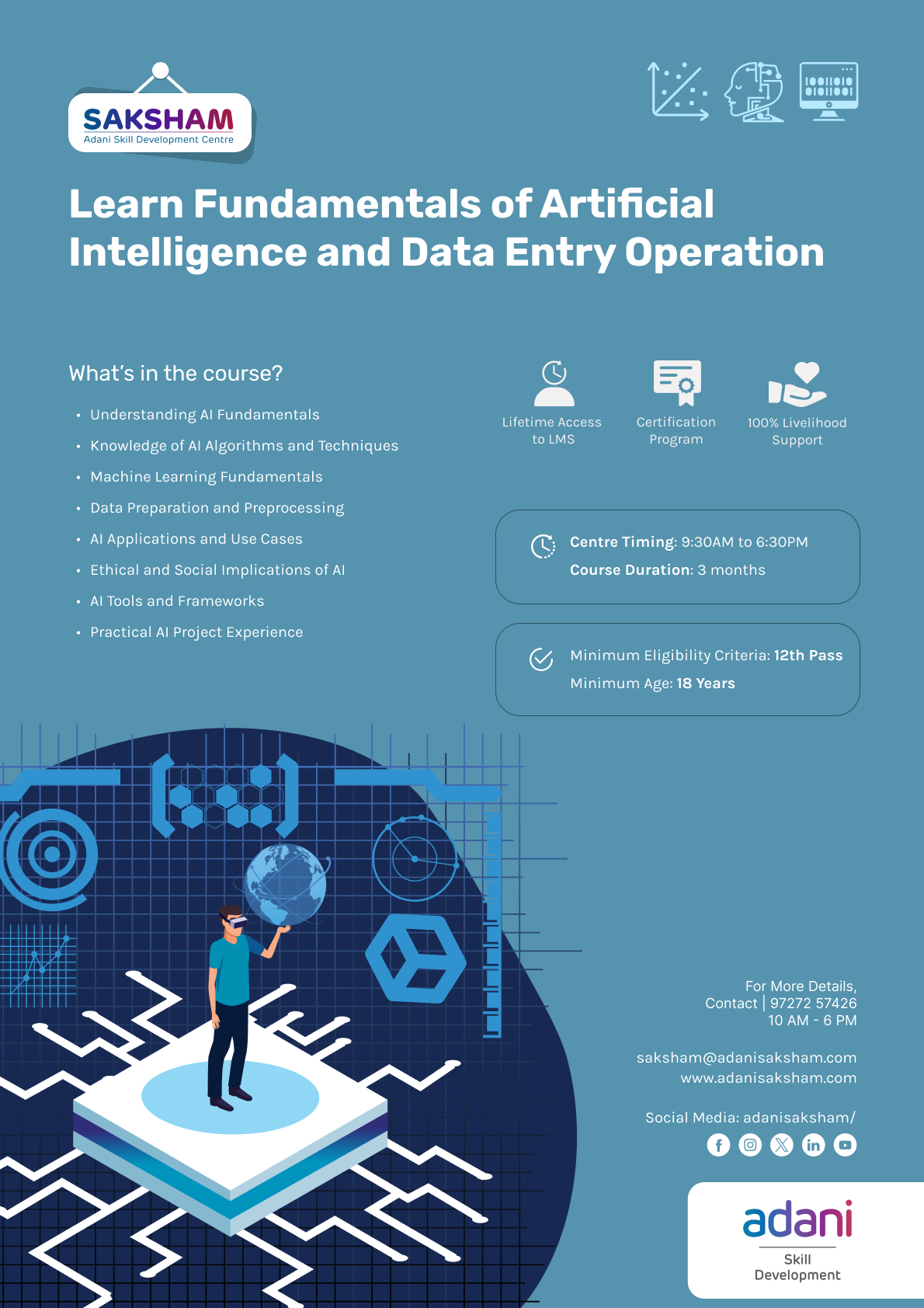
The Foundation of AI program offers a structured introduction to the core ideas shaping modern artificial intelligence. The curriculum focuses on how AI systems function, how data is processed, and how machine learning models are developed. Learners work with real tools and frameworks, allowing them to understand both the technical and ethical dimensions of AI.
What You Will Learn
  • Fundamental concepts that define artificial intelligence
  • Application areas of AI across industries
  • Key AI algorithms and their practical applications
  • Ethical, social and regulatory considerations in AI
  • Basics of machine learning and model-building
  • Data preparation, cleaning and preprocessing techniques
  • Practical project work to build confidence in applying concepts
  • Hands-on familiarity with commonly used AI tools and frameworks
Course Available in Centres:
  • Boyareddypalli (AP)
  • Chaibasa (JH)
  • Chanda (MH)
  • Chilhati - Pachpedi (CG)
  • Dhamra (OD)
  • Ganeshpahad (TS)
  • Goa (GA)
  • Godda (JH)
  • Hazaribaugh (JH)
  • Jamul (CG)
  • Krishnapattnam (AP)
  • Kuduthini (KA)
  • Kymore (MP)
  • Lakheri (RJ)
  • Madihaan_Mirzapur (UP)
  • Narol (GJ)
  • Raipur (CG)
  • Sindola (MH)
  • Sindri (JH)
  • Singrauli (MP)
  • Tamnar (CG)
  • Tandur (TS)
  • Thondubavi (TS)
  • Tikaria (UP)
  • Wadi (KA)
  • Warisaliganj (BR)
300+ Hours 12th Pass 18+ Years 9:30 AM – 6:30 PM
Cyber Security
Course Overview
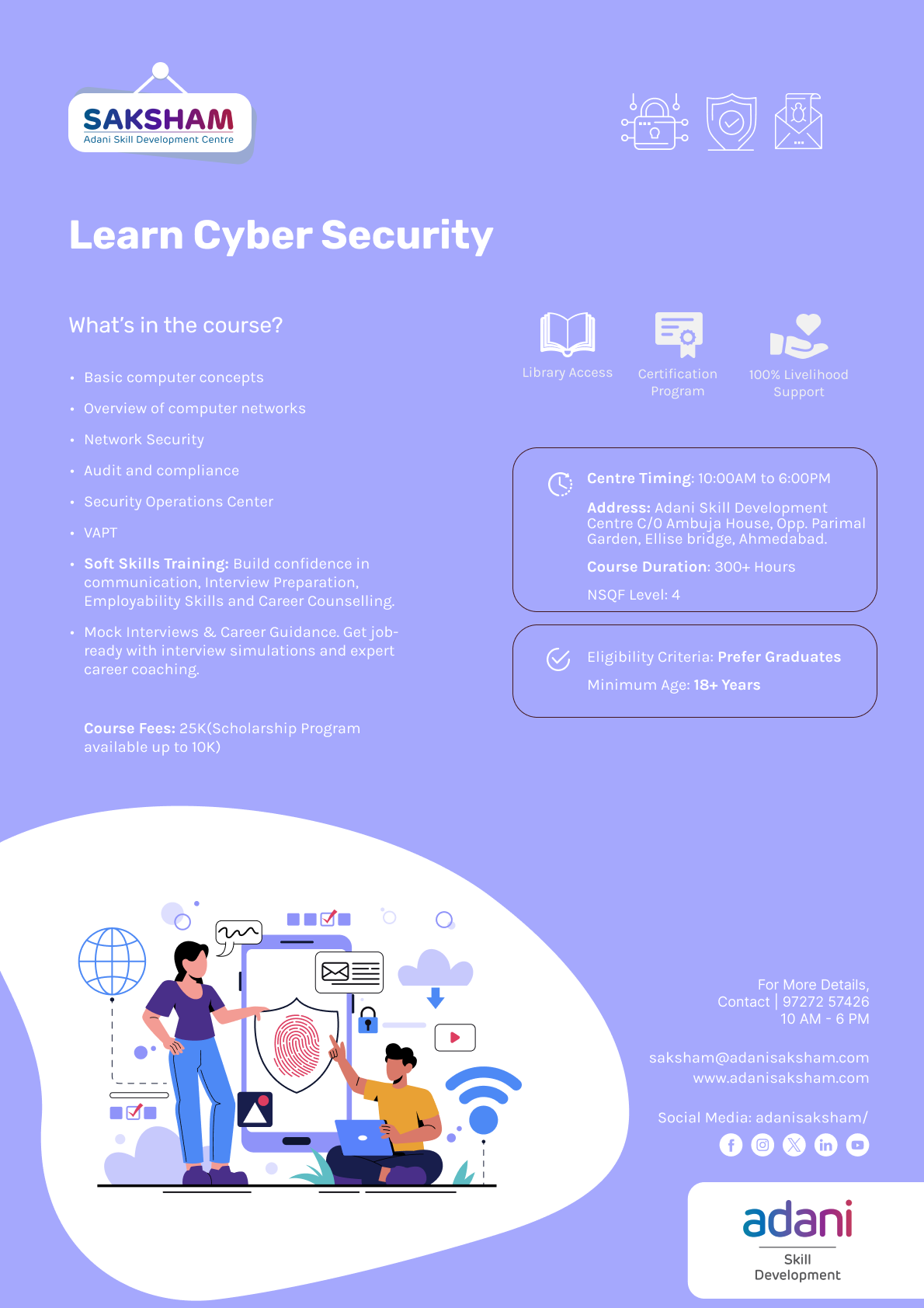
The Cyber Security program equips learners with foundational competencies needed to understand and protect digital infrastructure. It covers how systems are structured, how breaches occur, and how security teams detect and respond to threats. Through guided practice, learners examine vulnerabilities, explore preventive controls, and build familiarity with real security workflows used in organisations. The course also includes professional preparation modules for job readiness.
What You Will Learn
  • Computer & OS Basics: Core concepts that impact cyber risks.
  • Network Foundations: Network types, protocols, communication models and common network vulnerabilities.
  • Network Security: Firewalls, antivirus, access controls and threat mitigation techniques.
  • Audit & Compliance: Standards, documentation and the role of compliance audits in ensuring organisational security.
  • Security Operations Centre (SOC): Monitoring, incident alerts, escalation processes and reporting.
  • VAPT Exposure: Understanding how vulnerabilities are identified and tested in controlled environments.
  • Professional Development: Communication, employability skills and interview preparation.
  • Career Support: Mock interviews and personalised guidance to prepare for entry-level cyber security roles.
Course Available in Centres:
  • Ahmedabad
300+ Hours NSQF Level: 4 Preferably Graduates 18+ Years 9:30 AM – 6:30 PM

Data Analytics
Course Overview
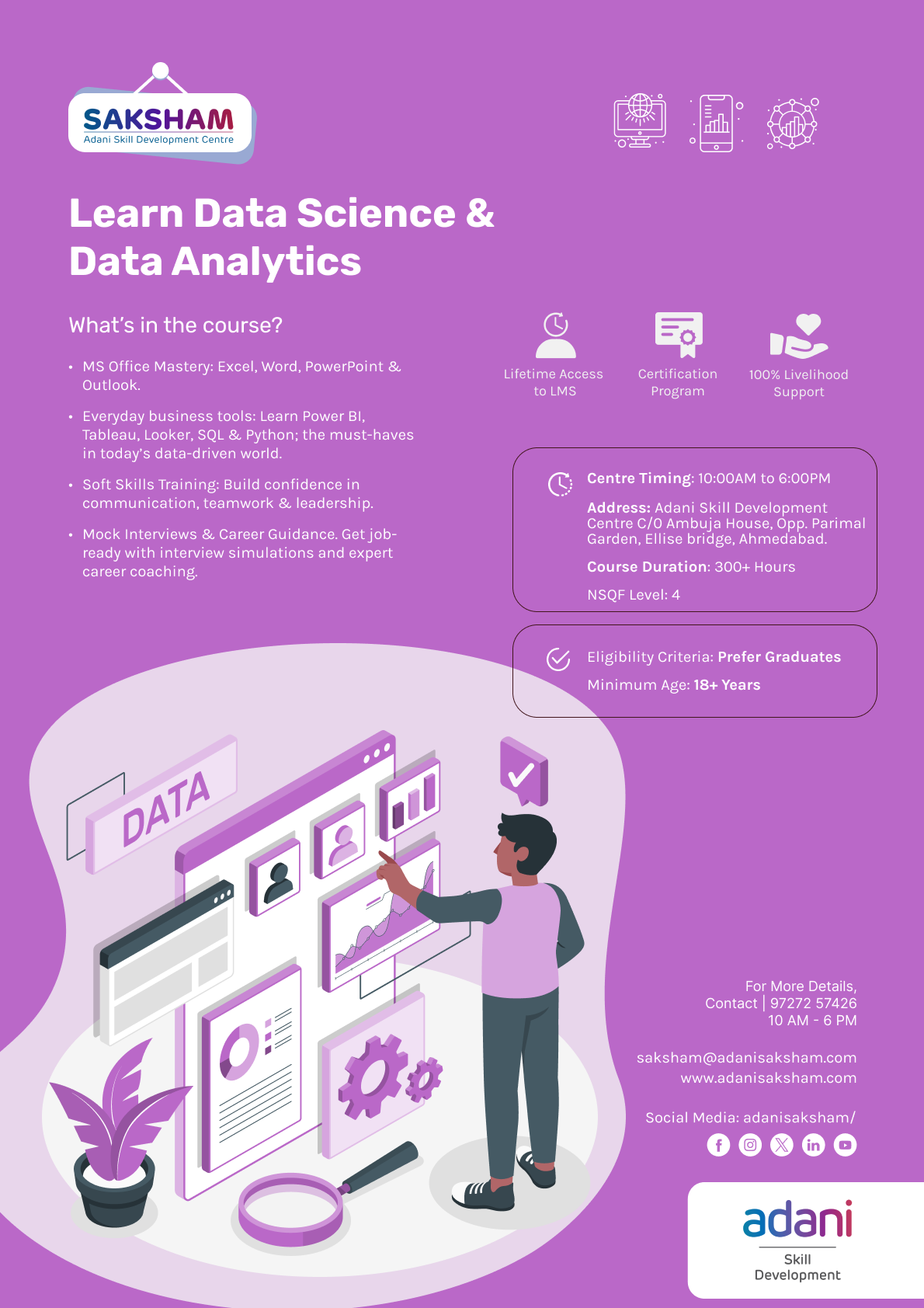
This program builds strong analytical capability for roles requiring data interpretation, reporting and decision support. It integrates the most widely used data tools in businesses today with foundational principles of data management. Learners develop proficiency in analysing datasets, creating visual summaries, and presenting insights effectively. The curriculum also strengthens communication and professional skills essential for data-oriented roles.
What You Will Learn
  • Analytics Tools: Hands-on training in Power BI, Tableau and Looker to create data visualisations.
  • Career Preparation: Mock interviews, resume preparation and personalised career counselling.
  • Python: Basic programming for data manipulation and simple analytical tasks.
  • Soft Skills: Communication, teamwork, problem-solving and workplace behaviour.
  • MS Office Suite:
    • Excel for data handling, formulas, pivot tables and dashboards.
    • Word and PowerPoint for reporting and presentations.
    • Outlook for professional communication.
  • SQL: Querying databases to extract and manage structured data.
Course Available in Centres:
  • Ahmedabad
300+ Hours NSQF Level: 4 Preferably Graduates 18+ Years 9:30 AM – 6:30 PM

Domestic Data Entry Operator (DDEO)
Course Overview
This course enables students to develop accuracy, attention to detail and digital competence required for administrative and data-driven roles. The program focuses on multiple aspects of managing information from understanding data structures to using commonly used office tools. Learners practice real-world scenarios such as updating records, maintaining logs, and ensuring compliance with information-handling standards.
What You Will Learn
  • Data Organisation: Structuring raw data, maintaining logs and preparing documents for digital entry.
  • Data Entry Techniques: Speed, accuracy, verification processes and error identification.
  • Digital Tools: Use of basic office applications for managing records and documentation.
  • Operational Discipline: Following data security, confidentiality and workplace protocols.
  • Practical Application: Hands-on practical projects for better understanding.
Course Available in Centres:
  • Boyareddypalli (AP)
  • Chaibasa (JH)
  • Chanda (MH)
  • Chilhati - Pachpedi (CG)
  • Dhamra (OD)
  • Ganeshpahad (TS)
  • Goa (GA)
  • Godda (JH)
  • Hazaribaugh (JH)
  • Jamul (CG)
  • Krishnapattnam (AP)
  • Kuduthini (KA)
  • Kymore (MP)
  • Lakheri (RJ)
  • Madihaan_Mirzapur (UP)
  • Narol (GJ)
  • Raipur (CG)
  • Sindola (MH)
  • Sindri (JH)
  • Singrauli (MP)
  • Tamnar (CG)
  • Tandur (TS)
  • Thondubavi (TS)
  • Tikaria (UP)
  • Wadi (KA)
  • Warisaliganj (BR)
300+ Hours 12th Pass 18+ Years 9:30 AM – 6:30 PM

FAQs

Yes. Courses such as Foundation of AI, DDEO, and GST Tally are structured for beginners, while Cyber Security, Data Analytics, and Remote Drone Pilot programs build progressively into advanced skill application.

Training includes hands-on practice through simulations, software tools, real datasets, and practical assignments aligned with industry workflows.

Depending on the course, roles include data analyst, cybersecurity support executive, drone pilot, data entry operator, and accounting or compliance executive.

Curricula are updated to reflect evolving digital tools, compliance needs, and operational standards relevant to today’s technology-driven workplaces.

Yes. Certificates are aligned with industry and sector requirements, improving employability across entry-level and mid-skill roles.

WhatsApp